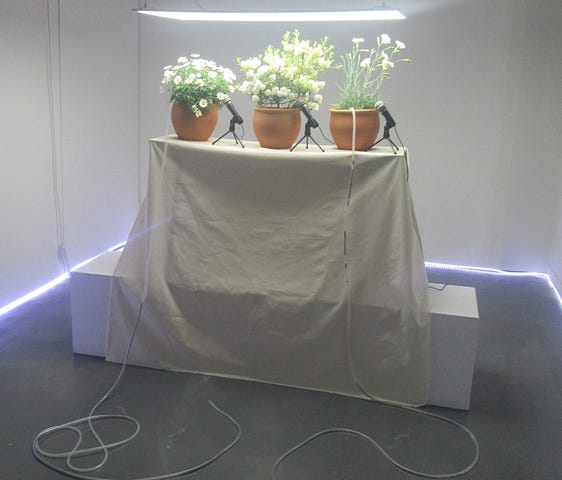
Joseph Beuys by Becs Boyd
By Worth Attention on 31-Jan-12 07:47:17 PM
I wish to thank Deborah Ravetzfor drawing my attention to this recent and very succinct article by Becs Boyd.
The article also contains many useful references to YouTube addresses which cover interviews with Joseph Beuys.
Joseph Beuys (1921-86)
Becs Boyd, Bridgehouse Art Portfolio Course 2011/12
It is clear from even the briefest sift of Beuys’ recorded interviews and secondary literature that here was a celebrity performer, a ‘Weltstar’ (1) , almost a deity in his lifetime, even up to the shepherd’s cloak and staff assumed in several well-known ‘actions’ (2) and his artistic ‘rebirth’ after a crisis in 1956. The legend owes much to Beuys’ own role in mythologising his biography (3) and to his hundreds of public recorded ‘conversations’, more numerous than those of any other artist. Twenty five years after his death, does his work stand scrutiny? Does it still speak in the absence of its creator? Was there a tension between Beuys’ creative activity and the need to teach, even to proselytise? What of his agenda did he achieve and what is his legacy?
Artistic agenda (4)
Born to the Third Reich in 1921, a volunteer member of the Hitler Youth and Luftwaffe and a fighter pilot, Beuys must have been very conscious of the power of art to promote socio-political ideals and of his own serious responsibility as an artist. His artistic agenda gained form during art studies in post-war Düsseldorf, when he explored connections between nature, human existence, mythology and philosophy. Abstract expressionism and pop art were emerging to challenge the ‘fine arts’, reflecting a materialistic post-war world disabused of utopian ideals where art could exist simply ‘for art’s sake’. By 1956 what Beuys described in interview as the ‘whole desperate situation of modern art’, which he felt had become both too narrowly academic and too commercially-driven, precipitated an ‘existential crisis’ or ‘death’, (wirkliches Sterben) (5) . Beuys’ crisis was the catalyst for a fundamental redefining of his artistic principles and the extension of his philosophy on the utopian potential of art into social and political action. His search through art for the ‘essence of things’ was as much to meet his own need for reconnection with solid, natural foundations as to reform both society and art to realign with fundamental natural laws.
From this point Beuys developed a clear social and political agenda for his art, summarised neatly by one critic, ‘the education of the individual through art, a fundamental revolution of our lives via a “direct democracy through referendum”, free access to all educational facilities and a restructuring of the economy based on ecological necessity’ (6). His philosophy drew much from Rudolf Steiner’s Anthroposophy movement, particularly the concept of ‘moral imagination’ and ‘individual freedom’ arising from a process of ethical discipline, and the concept of ‘social threefolding’, a social theory in which politics, economics and culture are allowed the freedom to mutually correct each other (7). Both Beuys’ and Steiner’s post-war critical ‘reorientations’ took this baton from many antecedents; Plato, Goethe, Schiller, Novalis, Dostoevsky, among others, had made connection between the perception of beauty and human capacity for love and moral action. Beuys’ frequent use of the word ‘freedom’ in relation to human imagination and creativity must therefore be understood in this strong moral context, not simply as denote hedonism or total choice.
Faith in the human imagination to lead humanity to a more ‘humane’ state of being translated into Beuys’ ‘expanded conception of art’ or ‘social sculpture’ (Sozialplastik). Beuys believed that art alone could be ‘a formula to solve world problems’ (8) because it could free the full range of human capacities, from intellect and intuition to love and spirituality. He said that art, as a creative effort encompassing philosophy, science and religion, could deliver Freedom, Democracy and Socialism (9) . He returned to the original meaning of the word ‘aesthetic’ as ‘enlivened being’, capable of individual and social transformation. Through art, he said, the ‘free individual’… ‘becomes creator of the world and experiences how he can continue creation’ (10). He expressed this famously, (borrowing from Novalis), as, ‘Every human being is an artist’, (Jeder Mensch ist ein Künstler) (11). It follows from this that the process of creative thought and speech which preceded or accompanied his physical images, sculptures and performance art ‘actions’, and his personality itself, a central constant in his work, are integral to the ‘art’. In Beuys’ universe art has subsumed the whole of creation, and the artist/Everyman, drawing on the higher nature released by his imagination, has become no less than the Creator, able to transform his world.
Beuys’ work and its development
In Beuys’ early work, which begins to explore human relationships with nature, often with reference to traditional cultures, drawing and watercolour sketches predominate, along with small sculptures. The main body of his post-war work augments drawing with 3-D sculpture using natural materials, performed ‘actions’ (from the 1960s), and hundreds of recorded ‘conversations’. As Beuys’ utopian mission gains solidity, his own role within his art develops, primarily as educator, but with strong undertones of shamanic healer and spiritual leader. Beuys the charismatic and eloquent persona, in his trademark felt hat, becomes one with his work.
From 1962 Beuys begins increasingly to use natural materials like fat, wax, honey, felt, copper and dead animals in conjunction with the ‘materials’ of language and of himself as performer and interpreter. These natural materials feature in many performance ‘actions’ as well as in static work. In one well-known action Beuys shod one foot with felt, the other with iron, covered his head with gold leaf and honey and talked to a dead hare about art (12) . In another he hid in in a felt cloak and, holding a shepherd’s staff, lived with a real coyote for several days in a New York gallery (13) . These natural materials are tactile and smelly, engaging a range of senses. Even in the absence of Beuys’ discourse their nature speaks strongly to a connection between the physicality of the viewer and a tangible, primal or natural, quite ‘unmodern’ world, linking the work with the act of living or survival (14) .
Understood in conjunction with Beuys’ discourse these works – both 3 and 4-D - assume a more sophisticated significance. For Beuys, for example, fat and wax represent the ‘energies in the individual and in society, the complex processes in the metabolism of a living organism, used to generate thoughts, spiritual feelings, work’ (15). The molten and solid forms of fat or wax represent the three stages of sculpture, as well as the development of the individual and society, bringing the ‘indeterminate’ and ‘chaotic’ through movement to a ‘determinate’, ‘crystalline’ or ‘healthy’ state. Felt is associated with warmth. Thus Beuys imbues sculpture itself with ‘life-giving power’ as well as power to create ‘energies of the spirit and imagination’ needed to put into action the human qualities of ‘freedom, solidarity and humanity’ (16).
Beuys draws many and detailed comparisons between various natural systems and mankind (17), and his sculptures of animals and references to hunting and herding refer back to the basis for human society (18). His many political art ‘actions’ are inevitably overt, often with an environmental, anti-war or anti-materialism message (19) . The performance art of his later years is often practical as well as provocative. One of his best-known environmental ‘actions’, ‘7000 oaks’, involving the planting over several years of 7000 trees next to the original 7000 stone markers he had placed, resulted in permanent improvement to the ecology of Kassel city centre (20).
Beuys approaches his themes in a variety of media, with political action and recorded conversations becoming increasingly important in the 1980s. Throughout his artistic life, however, he continually reiterates his three main ideas – that the artist is present in his work, that the future of human society requires a return to a fundamental forgotten state of awareness, and that ‘everyone is an artist’.
What of his agenda did he achieve and what is his legacy?
During his lifetime Beuys was heralded as the ‘most influential European artist of all time’ (21), and he is still recognised as one of the foremost artists of the 20th Century. Yet one can detect a tension between the artist and the educator. Beuys’ utopian vision of creativity, of inspiring the transformative capacity of humanity through art, seems at times at odds with the didactic presence of the artist as a central subject and interpreter. His persona, although charismatic, does not appear to have been one that naturally inspired intimacy or connection. Indeed it is possible that the all-consuming creative process is by its nature at odds with the emotional empathy required for Beuys’ utopia. His ‘conversations’ are not those of an educator seeking connection through clarity, but seem deliberately to limit accessibility. Although his art is often thought-provoking and purports to engage the range of senses, one feels that much of his work and discourse operates largely on a cerebral level, rather than evoking a transformative response through a more visceral or spiritual aesthetic sense. Now, in the absence of the charisma and energy of Beuys himself, what remains of his work are like interesting artefacts more than living art works, perhaps even an ironic reminder of the mere substance to which we return in the absence of the creative imagination.
There is no doubt, however, that Beuys has had a profound and lasting influence. His utopian vision for art translated the ideas of earlier art movements for a jaded, post-war, morally and spiritually uncertain 20th century audience, which was ripe for a return to the solid and wholesome. His groundbreaking approach to art, as performance artist, educator and political activist, redefined the traditional role of the artist as maker to focus on opinions, personality and actions. Beuys’ concept of social sculpture continues to have strong currency within and beyond art in the social justice, environmental art, performance art and sustainability movements of the 21st century (22). While he may not have succeeded in transforming society, Beuys’ life and work have successfully fired and inspired the imaginations of many individuals to transform their world in beautiful and practical ways.
(1) Joseph Beuys im Gespräch mit Herman Schreiber (1980) http://www.youtube.com/watch?v=iGWA2iGTUyg
(2) For example ‘Coyote/Joseph Beuys: I like America and America likes Me, Galerie Rene Block New York, 1974’; ‘Celtic +˜͠͠ ˜͠͠ ˜͠͠ ˜͠͠ ˜͠͠, civilian air raid shelter, Basel, 17 Sept-2 Oct 1971’.
(3) Borer A, (1996), p.13, and ‘Lebenslauf/Werklauf 1964’, Beuys’ fictionalised account of his life.
(4) For a summary of Beuys’ biography, see Appendix I
(5) my transl. Joseph Beuys: Krise und Selbstheilung (1980), http://www.youtube.com/watch?v=N-NqCJbvhX8
(6) Borer (1996), p.7.
(7) http://www.rudolfsteinerweb.com/Threefold_Social_Order.php
(8) Beuys quoted in Harlan, p.14
(9) my transl. Joseph Beuys - Public Dialogue (Excerpt 2. Part 1/2) http://www.youtube.com/watch?v=A7_PiPv6YVo
(10) Beuys quoted in Harlan, p.17.
(11) Beuys statement dated 1973, first published in English in Caroline Tisdall (1974), Art into Society, Society into Art (ICA, London), p.48.
(12) ‘how to explain pictures to a dead hare’, Galerie Schmela, Düsseldorf, 26 November 1965;
(13) ‘I like America and America likes Me‘, Galerie Rene Block, New York, 21-25 May 1974.
(14) There are many examples, including, ‘Queen Bee’ 1, 2 and 3, 1952; ‘Dead man’ 1955; ‘cross with kneecap and hare’s skull’, 1961; ‘Chair with fat’, 1963; ‘Snowfall’, 1965.
(15) Jeder Mensch ist ein Künstler (Portrait) 4/6 http://www.youtube.com/watch?v=tPqifQA0sfM&feature=related
(16) my transl. Jeder Mensch ist ein Künstler (Portrait) 4/6 http://www.youtube.com/watch?v=tPqifQA0sfM&feature=related
(17) For example, Harlan (2004).’Form, Structure and Substance’, pp.80-90.
(18) Jeder Mensch ist ein Künstler (Portrait) 4/6 http://www.youtube.com/watch?v=tPqifQA0sfM&feature=related ; eg Das Rudel (The Pack), 1969; Scene from the Stag Hunt, 1961.
(19) These include ‘Sonne statt Reagan, 1982’ (sun instead of rain/Reagan), an anti-nuclear song and music video with an optimistic theme.
(20) ‘7000 oaks, 1982, Friedrichsplatz Kassel, documenta 7’
(21) my transl., Joseph Beuys im Gespräch mit Herman Schreiber (1980), http://www.youtube.com/watch?v=iGWA2iGTUyg
(22) Many contemporary artists demonstrate the influence of Beuys, for example Thomas Hirschhorn, Maurizio Cattelan, Pawel Althamar, Matthew Barney; Oxford Brookes University houses the Social Sculpture Research Unit www.social-sculpture.org, founded on Beuys’ philosophy, has supported the work of many artists.
References
http://www.joseph-beuys.com/
http://www.rudolfsteinerweb.com
http://www.social-sculpture.org,
Joseph Beuys im Gespräch mit Herman Schreiber (1980), http://www.youtube.com/watch?v=iGWA2iGTUyg
Joseph Beuys: Jeder Mensch ist ein Künstler (Portrait) 1/6 http://www.youtube.com/watch?v=OyLKS-F4HwU
Joseph Beuys: Jeder Mensch ist ein Künstler (Portrait) 2/6 http://www.youtube.com/watch?v=xDXqTzXejh4&feature=related
Joseph Beuys: Jeder Mensch ist ein Künstler (Portrait) 4/6, http://www.youtube.com/watch?v=tPqifQA0sfM&feature=related
Joseph Beuys: Jeder Mensch ist ein Künstler (Portrait) 5/6, http://www.youtube.com/watch?v=ssc-3mAGlaA&feature=related
Joseph Beuys - Public Dialogue (Excerpt 2. Part 1/2) http://www.youtube.com/watch?v=A7_PiPv6YVo
Joseph Beuys: Krise und Selbstheilung (1980), http://www.youtube.com/watch?v=N-NqCJbvhX8
Escape into Life: the legacy of Joseph Beuys (2010) http://www.escapeintolife.com/essays/legacy-joseph-beuys
Bonami, F. (2005) ‘Legacy of a myth maker’, Tate etc., http://www.tate.org.uk/tateetc/issue3/legacymythmaker.htm
Borer, A. (1996) The Essential Joseph Beuys, translated by Elaine Briggs, Thames and Hudson.
Harlan, V. ed. (2004), What is Art? Conversation with Joseph Beuys, translated by Matthew Barton and Shelley Sacks, Clairview.
Tisdall, C. (1979), Joseph Beuys, Guggenheim.
Usher, S, ‘The Threefold Social Organism, an introduction’, in Rudolf Steiner and Economics http://www.rudolfsteinerweb.com/Rudolf_Steiner_and_Economics
Appendix I - Biographical Summary
Some of the key links between Beuys’ life and his artistic development are summarised below:
1921-45
• Born in 1921, early life in Kleve, near Dutch border with Germany, spent in the shadow of fascist politics. Voluntary member of Hitler Youth and Luftwaffe, claimed to have been revived after a crash by Tatar nomads using fat and felt , which later became important to his work.
1945-61
• 1946-53 Student of ‘Monumental Sculpture’ at State Academy of Arts in Düsseldorf
• Produced thousands of drawings and some sculpture. Began to develop artistic agenda, exploring connections between nature, human existence, mythology and philosophy.
• 1956 suffered an ‘existential crisis’ or ‘death’, (wirkliches Sterben), ascribed to post-war trauma. In interview he blamed it in part on the ‘whole desperate situation of modern art’ (my transl.), which he felt had become both too narrowly academic and too commercially-driven. Crisis was catalyst for a fundamental redefining of his artistic principles and the extension of his philosopy on the utopian potential of art into social and political action .
1961-72
• Professor at the State Academy of Arts in Dusseldorf (1961-72). Abstract expressionism and pop art had emerged to challenge the ‘fine arts’, reflecting a materialistic post-war world disabused of utopian ideals where art could exist simply ‘for art’s sake’. Beuys chose the opposing path.
• Early 1960s active in the Fluxus movement, a network of artists with social and communitarian aspirations.
• Formulated theories on the social, political and spiritual function of art, developing his public artistic persona as ‘shaman’, spiritual leader and teacher.
• Public figure from the mid-60s, putting his philosophy into practice in a range of performance art ‘actions’ with a social or political agenda, which catapulted him into the media and the public stage. Translation of his principles into his professional life by removing entrance requirements for the Academy on the grounds of his core belief that ‘Everyone is an artist’ led to his dismissal in 1972.
1972-86
• Celebrity artist, philosopher and political activist. Founded associations, including the German Green Party, continued as prolific creator of art – expressing his theories of ‘social sculpture’ in ‘static’, ‘action’ and spoken form.
• Died 1986 Düsseldorf